Stories

A Son’s Popkes Summer break

In the meantime…

I’ve started working on a new pattern, a Corgi dog! I’m hoping to publish it the last week of September.

🐶

Last week, I thought it would be a great idea to share some behind-the-scenes photos of my design process on Instagram. However, my timing was a little off, as Summer break is just around the corner. My boyfriend works in education and has a long holiday, and this break is important for me too. I choose not to work during this period or, to put it another way, I don’t start any new designs during these six weeks.

Taking this time away from thinking about ā€œhow should I do this?ā€ or ā€œhow can I create that?ā€ really helps to ‘unravel’ my mind. It allows me to return after Summer feeling refreshed and brimming with new ideas. Since much of my inspiration comes from nature, I use this period to wander outdoors and try to see as much wildlife as possible.

I’ve already had a fabulous experience in my village following a family of long-eared owls. I discovered the chicks just as they had branched and was able to follow them for several weeks. It was absolutely wonderful to watch them grow up. And just a few days ago, when I couldn’t find the owl family, I discovered there’s a kingfisher family living in a local pond. I had so much fun taking pictures of them hiding underneath a silly mosquito net!

Of course, new ideas always pop into my head, but for once, I don’t feel the need to act on them right away.

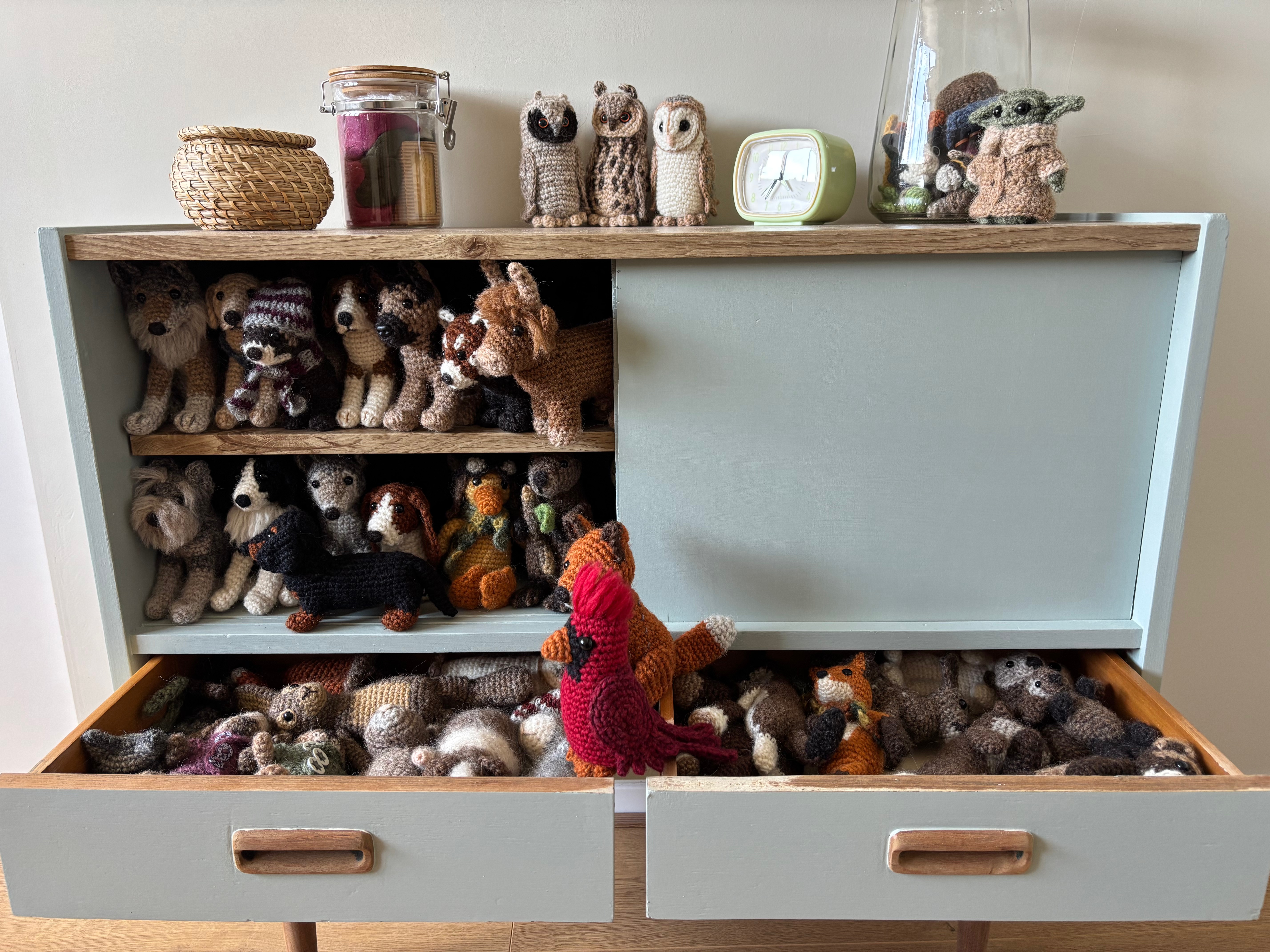
That said, I’m excited about the idea of sharing more Instagram stories about my creative process, and I plan to continue with that. I have a lovely home studio that I can’t wait to show you. It looks very organised right now, but when I’m working on a new pattern, my desk quickly fills up and things get delightfully messy.

After the Summer break, I’ll finish the sheep project I’m working on, and I’m also planning to create an improved tuxedo cat pattern. And my shops, of course, stay open, everything there goes fully automatically.

For now, I wish you a wonderful, fun, and adventurous Summer filled with yarn crafting and more. I’m currently knitting a rather cool stripy henley sweater, fingers crossed I can finish it!

Have fun, crafty peeps!
Patterns

Doerak, crochet German Shepherd pattern

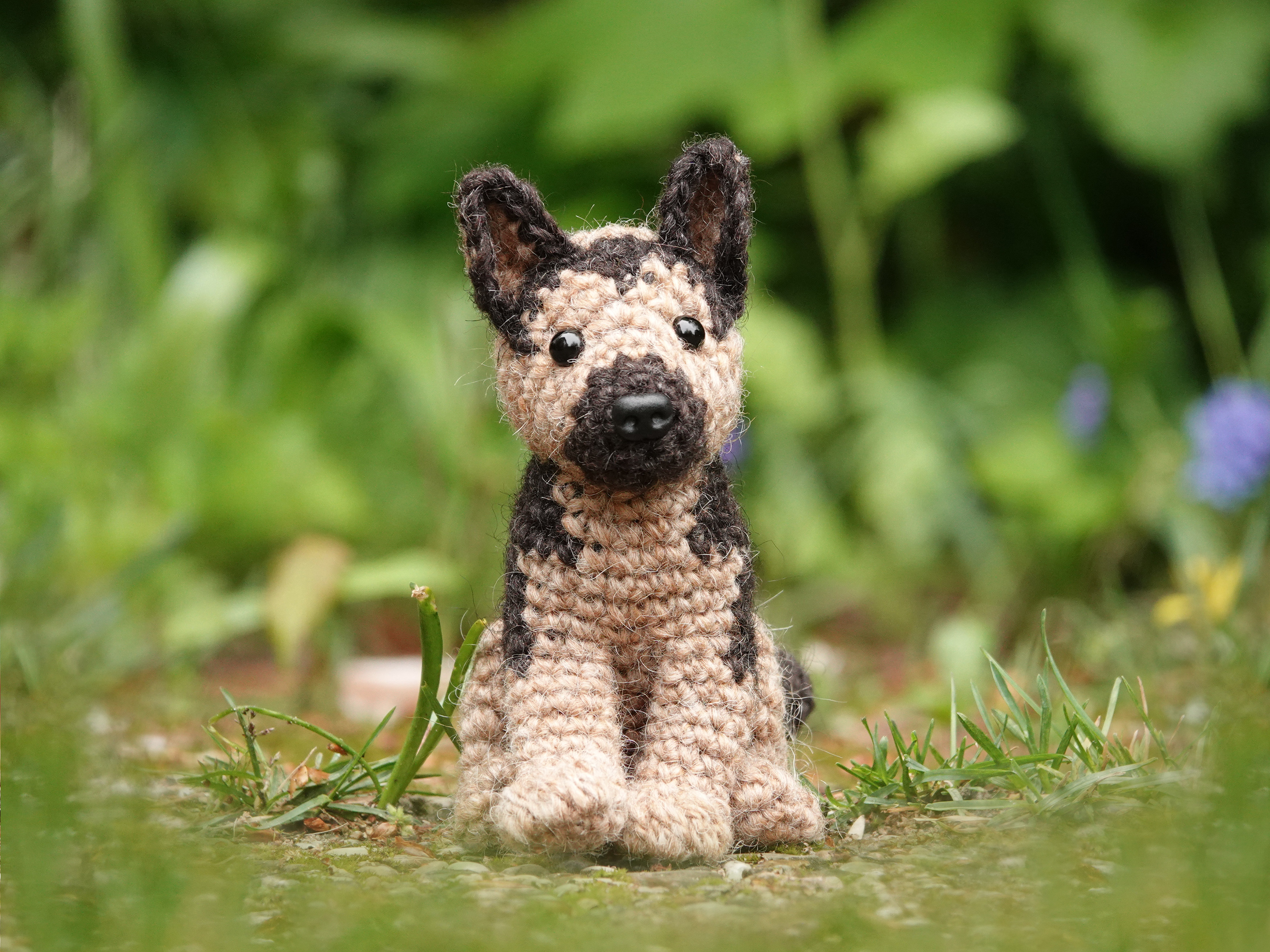
After many requests for this pattern, I am excited to finally present my German Shepherd amigurumi. This is Doerak, a crocheted German Shepherd puppy!

Crochet dog outdoor

You might be wondering about the name Doerak. It comes from a German Shepherd puppy I fell in love with as a child during a holiday. In Dutch, “Doerak” affectionately means something like “little scoundrel.”

I began this pattern with full confidence but soon realised that deciding on the colouring was quite challenging. What is the most standard German Shepherd coat? I struggled to find a definitive answer because there are so many variations! For my version, cuteness was the key factor, so I experimented with different face colourings and chose the one that looked most like a German Shepherd puppy. Since I made several versions, some of which turned out really nice, I added an extra face option to the pattern. For Doerak, I chose the lighter colour around the eyes, the other version gives a darker appearance, with black around the eyes.

For the body, I used a basic colouring that makes it easier for you to customise it to match your own dog’s coat. I know many people want to create amigurumis of their own or a friend’s dog, and every dog “has its own coat.” My advice for anyone adjusting the colouring is to start with one of the existing versions as your base (you can use leftover yarn for this). Instead of a traditional stitch marker, use a contrasting coloured strand to mark the first stitch of each round, carrying it up with every round. This clearly identifies the first stitch and helps you divide your colour sections accurately. By doing this, you’ll have a clear reference point to customise the colour placement while maintaining the overall structure of the pattern. I also explain this in the pattern.

I’m already quite fond of my little crochet K9, and I hope this pattern inspires many unique dog amigurumis! Below are some more pictures of Doerak, the crocheted German Shepherd, along with all the information you need.

This crochet dog is made with Istex Lett Lopi— a 100% wool yarn known for its fuzziness. The dog is 5.5 inch /14 cm high sitting. The pattern includes clear and colour-coded instructions on how to crochet and assemble the doll, along with instructional images and notes next to the text. You’ll also find pictures of the finished doll at the end. In the pattern, you’ll discover what materials you need as well as the yarn colour numbers—in short, everything necessary to create your own realistic German Shepherd amigurumi! All the additional information you need to know about this pattern you can find in the shop listings. You can purchase it in my shop at Ravelry or Etsy.

And heads up! This pattern has a one-dollar release discount until April the 24th. Feel free to let me know if you need any additional information!

Patterns

Tippy, realistic crochet raccoon pattern

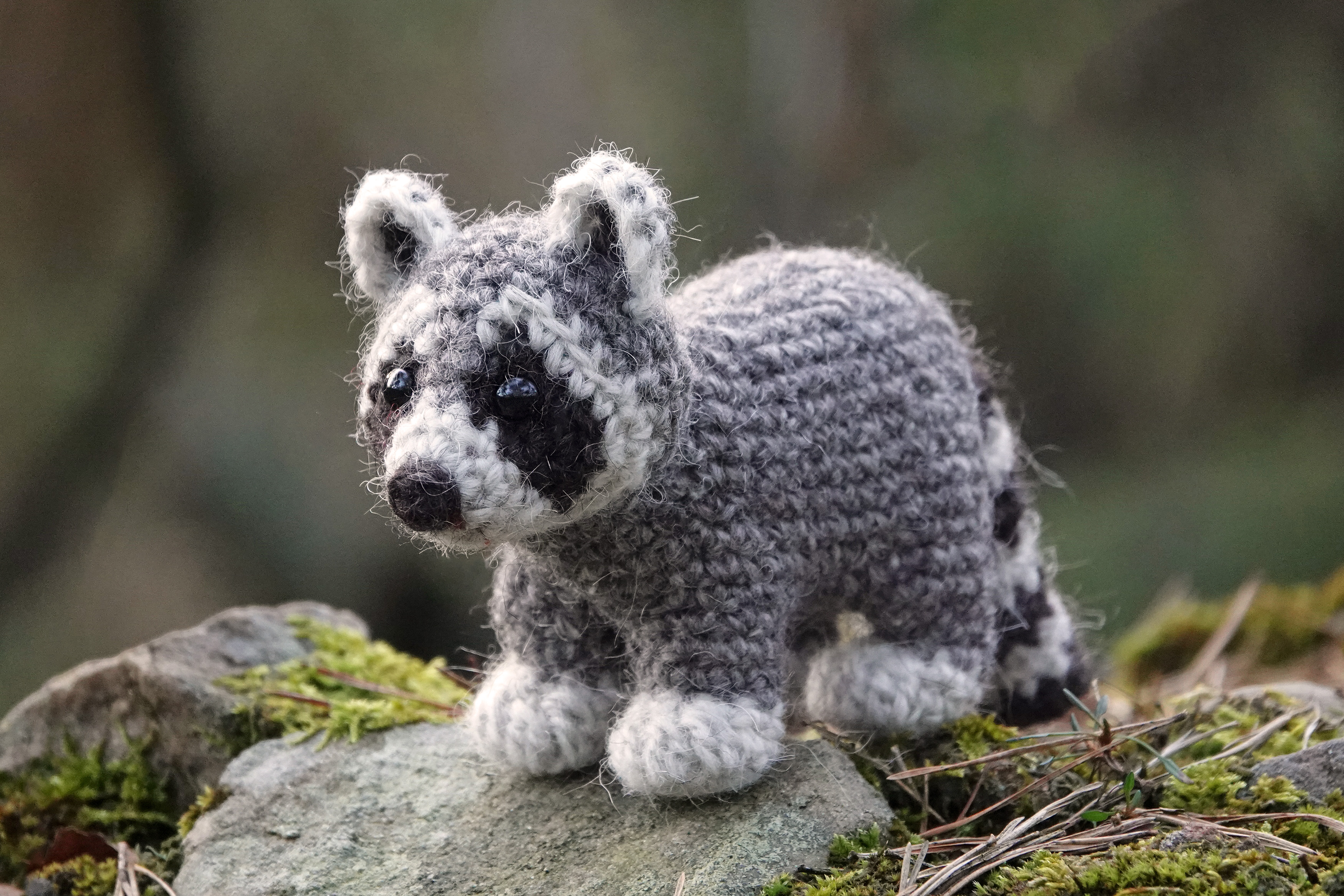
What’s with all that racket? It is with great pleasure that I present to you something new and exciting. Meet Tippy, the realistic crochet raccoon!

crochet raccoon pattern

Making a new raccoon pattern has been long on my list, along with many other animals, and it is often hard to choose. Raccoons aren’t a native species where I’m living, but these smart little creatures are sneakily spreading throughout nature. Most of them are zoo escapees, and once in the wild, they are very successful. I must admit I absolutely love these animals. I’ll never forget the moment I first spotted one on my camera trap, it was an absolute surprise that stole my heart!

A Creative Journey

In 2014, I created my first raccoon amigurumi. Wasby is a cute sitting doll with a striking face. But I’ve learned so many new skills since then and wanted to create something more realistic.

As I wrote in an earlier post, I’m not a fan of how AI is interfering with crochet animals. However, with a bit of reluctance (and maybe a little shame), I must admit that the creations AI has produced are amazing! This style, a blend of plush animals and crochet, unexpectedly inspired me to push my creative boundaries rather than discourage me. When I designed this raccoon doll, I used both images of real raccoons, plushies and this newfound style for inspiration. I experimented with body shapes, creating shorter and wider paws while refining proportions. My goal was to make the body as small as possible while keeping it realistic and I’m thrilled with how it turned out!

Crafting Challenges and Discoveries

I attempted completely seamless designs but found they lost the whimsical character I love. After multiple iterations, I realised that sewing the head to the body allows for more expressiveness, a technique that gives my animals their unique personality. One of my editors perfectly captured Tippy’s essence, commenting, “It looks just like a little baby raccoon ā¤ļø.”

Here are some more pictures of Tippy the raccoon amigurumi, and below them, you can find all the information you need.

This is an intermediate pattern made with basic stitches. The difficulty lies in creating the seamless body. Instructions for working up the body are well explained.

This crochet raccoon is made with Istex Lett Lopi— a 100% wool yarn known for its fuzziness. The raccoon is 6 inches (15 cm) from nose to bottom. The pattern includes clear and colour-coded instructions on how to crochet and assemble the doll, along with instructional images and notes next to the text. You’ll also find pictures of the finished doll at the end. In the pattern, you’ll discover what materials you need as well as the yarn colour numbers—in short, everything necessary to create your own realistic raccoon amigurumi! All the additional information you need to know about this pattern you can find in the shop listings. You can purchase it in my shop at Ravelry or Etsy.

And heads up! This pattern has a one-dollar release discount until February the 6th. Feel free to let me know if you need any additional information!

Patterns

Merley, crochet highland cow pattern

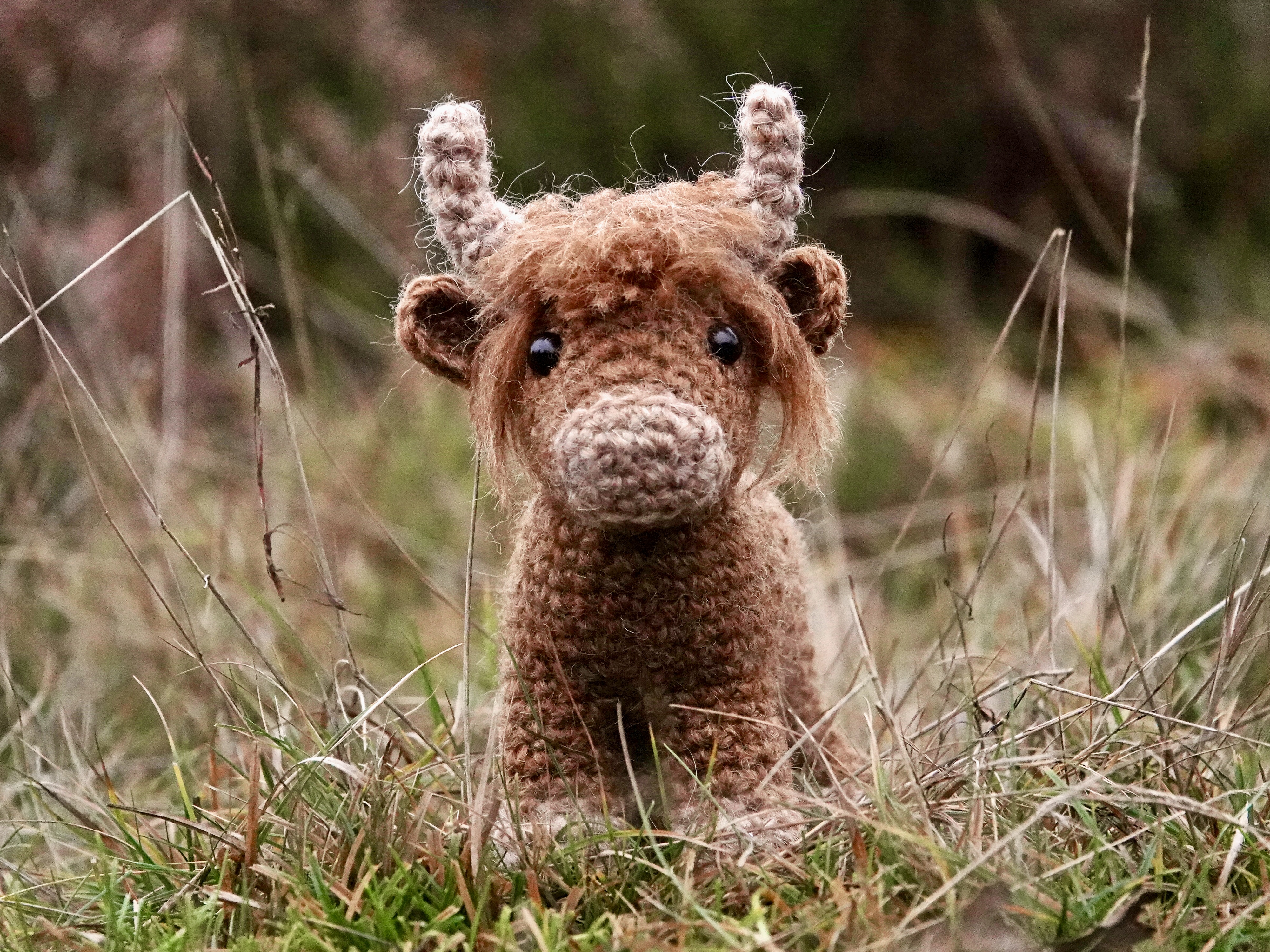
With great joy, I present to you this wild-looking, friendly beast: I designed a pattern for a Scottish Highland cow!

Realistic crochet highland cow pattern

This amigurumi pattern has been on my to-do list for quite some time, but a very enthusiastic customer inspired me to design one now. I’ve loved these cows for a long time, when we go hiking, we often see them. They play an important role in our nature reserves as large herbivores, helping to keep grasses at bay so that more vulnerable plants have a chance to thrive. They are impressive creatures with their huge horns and wild fur, yet they are among the friendliest cows.

Designing an animal like this presents a fun challenge for me as a creator. The horns and hair add extra cuteness to the crochet animal. My goal was to create an easy-to-crochet cow that looked both striking and cute. However, I faced a dilemma in deciding how hairy to make it. I could either cover it in hair or simply add hairy details. I worried that an entirely hairy cow might make the pattern less appealing, and when I pictured it, the cow wasn’t fully hairy. I prefer to see the texture of the crochet stitches, so I decided that adding hairy details would work best for what I had in mind.

I envisioned this Scottish Highland amigurumi as a stocky doll on all fours with a sweet, furry face. As I designed the head, the placement of the hairy parts influenced its expression. After several test faces, I created one that I thought was perfect. However, it gave Merley a more serious look than I intended. I wanted her to have an open expression, so I decided to use my first design, which had a spontaneity that I really liked.

The initial versions of the body had legs that were way too long. I had to shorten them much more than I anticipated. My boyfriend was confident that shorter legs would look better, so I took his advice and omitted four rounds. He was right; this adjustment gave the amigurumi cow exactly the stocky look I hoped for! Due to the lack of a suitable colour in my favourite Istex Lett Lopi yarn, I used two strands of Istex Einband Lopi yarn held together. The most common colour for Scottish Highland cows is a golden rusty hue. Lett Lopi’s rust is too red, and the brown colours aren’t warm enough. Einband’s almond heather comes closest.

Here are some more pictures of Merley the crochet Highland cow, and below them you can find all the information you need about the pattern.

This is an intermediate pattern made with basic stitches. The difficulty lies in creating the seamless body and using rls stitches to achieve the hairy details. Instructions for working up the body are well explained, and I’ve also created a video tutorial for the rls stitch.

This crochet cow is made with a combination of Istex Einband loop and Istex Lett Lopi—both 100% wool yarn known for its fuzziness. The cow is 6 inches (15 cm) long. The pattern includes clear and colour-coded instructions on how to crochet and assemble the doll, along with instructional images and notes next to the text. You’ll also find pictures of the finished doll at the end. In the pattern, you’ll discover what materials you need as well as the yarn colour numbers—in short, everything necessary to create your own realistic Scottish highland cow amigurumi! All the additional information you need to know about this pattern you can find in the shop listings. You can purchase it in my shop at Ravelry or Etsy.

And heads up! This pattern has a one-dollar release discount until December the 18th. Feel free to let me know if you need any additional information!

Patterns

Fronsky, realistic tawny owl pattern

It is with great pleasure that I present to you a new realistic crochet owl: Fronsky, the tawny owl!

realistic crochet owl

I had originally planned to create another animal, but this summer I saw my first adult tawny owl and later spotted a second one. Having seen tawny owl chicks this spring, I was eager to see an adult. After some research, I discovered a few roosting spots where owls are regularly seen. Visiting sites like these isn’t usually my thing, but for a chance to see a roosting tawny owl, I had to make an exception. During our first three visits, the owl was not present, which left me disappointed. However, on our fourth visit—a sunny afternoon—the owl was there! What a delightful sight it was! I found it almost magical how that gorgeous creature sat calmly and even looked at us from its perch. I was overjoyed and managed to take a few amazing pictures.

A few weeks later, we travelled to Germany. During a hike, we stumbled upon an old corn mill that showed signs of a roosting owl. There were droppings around, pellets, and feathers stuck to the wall. I checked for the owl but found none. Later that week, we took an evening stroll after a day of rain. As we walked the path to the mill, I wondered if there might be an owl now. When we were almost there, I carefully walked beneath a large chestnut tree and cautiously looked up at the mill. And there it was! A huge gray morph tawny owl perched on a beam—it didn’t even fully open its eyes when I looked at it. This one was much closer than the first one I saw, and I finally realized just how large they are. My holiday was perfect!

When I returned to work, my mind was so full of owls that the only thing I could do was crochet another owl pattern. Since I’ve already made several species of owls, I could easily adapt those patterns into a chubby tawny owl. That sounds easier than it is though, but at least I didn’t have to start from scratch. Real owls vary significantly in size, but I decided to make this one slightly bulkier because I like all my dolls to be about the same size. Choosing the colours for this owl was challenging; however, to keep it simple, I decided to omit the rust colours of the brown morph and instead go for a more greyish morph—like the owl I saw in Germany. This way, it can be made using only three colours, which is more than enough.

An interesting detail: for this owl, I adjusted the feet. Owls have two toes at the front of their feet and two at the back. When I made my other owls, I didn’t know this detail, and I bet many of you might not either.

Here are some more pictures of Fronsky the tawny owl amigurumi. Below them you can find all the information you need about the pattern.

Pattern Details

This is an intermediate pattern made with basic stitches. The difficulty lies in the colour changes; the strands can quickly become tangled, so you need to keep your focus!

This crochet owl is made with Istex Lett Lopi—a 100% wool yarn known for its fuzziness—and stands 5.5 inches (14 cm) tall. The pattern includes clear and colour-coded instructions on how to crochet and assemble the doll, along with instructional images and notes next to the text. You’ll also find pictures of the finished doll at the end. In the pattern, you’ll discover what materials you need as well as the yarn colour numbers—in short, everything necessary to create your own realistic owl amigurumi! All the additional information you need to know about this pattern you can find in the shop listings. You can purchase it in my shop at Ravelry or Etsy.

And heads up! This pattern has a one-dollar release discount until my birthday on October 6th. Feel free to let me know if you need any additional information!