Face & expression, Tips & Tricks

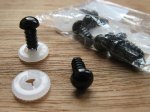
Animal safety eyes

When I tried different eyes for my lop bunny pattern, I noticed that if I used coloured eyes, they seemed smaller than the same size of black eyes. Because I hadn’t taken that into account, I ordered a bunch of eyes in black and brown and couldn’t use the brown ones because they looked much too small. I had to buy new eyes.

I decided to write a post about this in my ‘Tips & Trick’s’  section to give you a heads up.

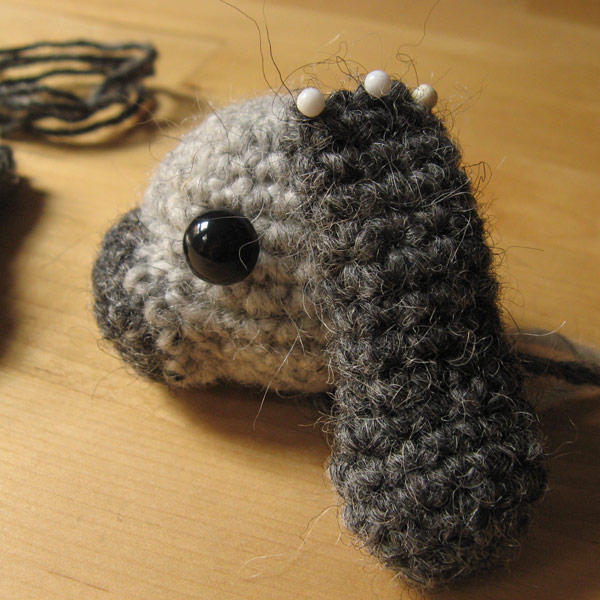
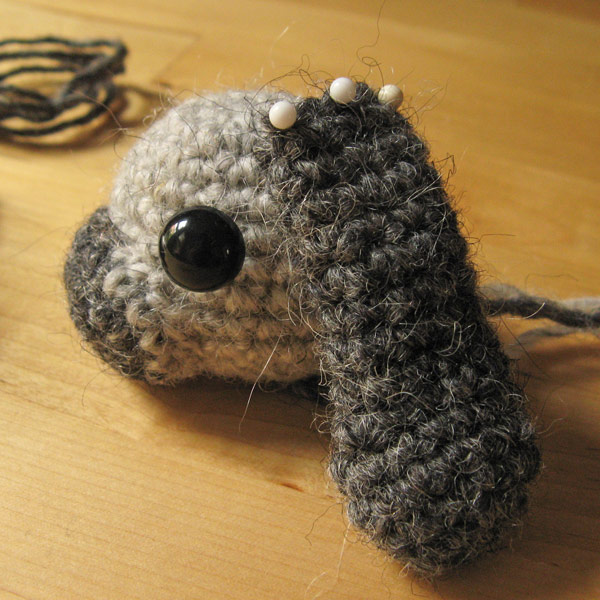
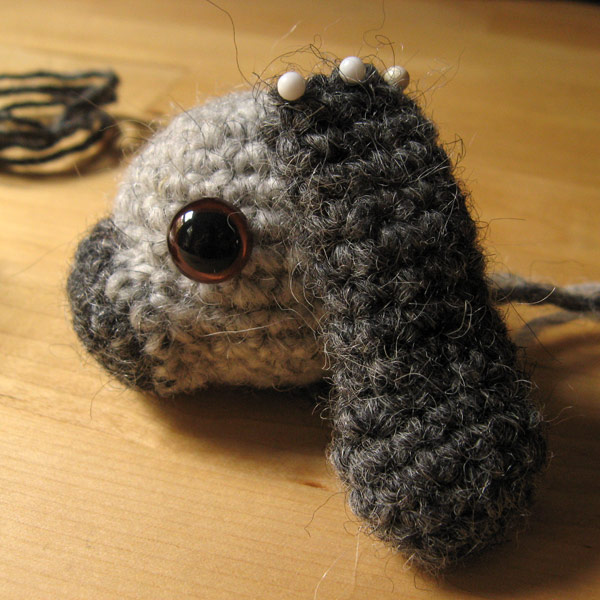
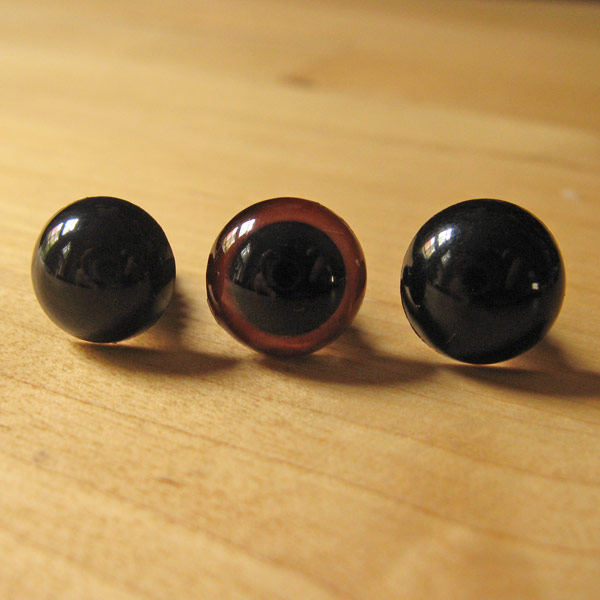
I made some pictures to illustrate this topic. (The eyes are not attached completely but are just inserted loosely without the safety backs.)

From left to right: 11 mm/0,43 inch black safety eyes, 12 /0,47  black safety eyes, same size brown safety eyes, the eyes in 11 mm, 12 brown and 12 black. I’m going to use the 11 mm black eyes or the 12 mm brown ones. The 12 mm black ones look too big.

Actually it’s quite logical a coloured eye looks smaller, because it has a transparent ‘orb’ on top of the flat coloured circle, which reflects the light a bit. You can also look a bit through the eyes.

Conclusion. If you’re going to use coloured eyes, keep in mind that they look smaller and buy them one step bigger or buy a few sizes so you have the right size for sure.


Stuffing & shaping, Tips & Tricks

Pellets as stuffing….eh?

Some crochet animals/amigurumi require a part of pellets as stuffing to give them more weight. My first amigurumi that needed pellets was Amineko. I looked on line to see what pellets are and where I could buy them. They are little round balls, mostly plastic and available in sewing and craft shops. After visiting a few hobby/craft shops I still hadn’t found my pellets. In the Netherlands they are hard to get. I’d also read toy bullets, marbles or rocks could be an alternative. Well, toy bullets I couldn’t find either and marbles are too large for many amigurumi I believe. That only left the rocks, which can be an option and they are easy to find in pet shops, but they’re kind of small and pointy.

There was something else I’d found in the hobby shop, called Hama Beads. They actually have an other ‘hobby’ purpose and I wasn’t sure they had enough weight, but they seemed worth the try, because the beads had the right size and come in little or big bags and many colours.

And it worked! Beads are heavy enough and good to shape because they are a bit rubbery. If you squeeze the part whit the beads, it keeps that shape and that is a very useful quality. The variety in colours comes in handy too if you haven’t crocheted very tight.

Here’s an example of the Dutch Hama beads:

"hama beads as pellets

Conclusion: enough weight, easy to shape with, available in many colours. One downside, I think you can only wash them cold, because if you use them for their real purpose, you have to use a flat iron to melt them together, so washing them hot might cause them to melt. I’m not sure about this, but am not going to try. If I’ll ever wash an amigurumi, I would do a could hand wash with baby soap, because that is best for wool anyway. That was an extra tip wasn’t it!

Goodbye and good luck!


Tips & Tricks, Tutorials

Paperclip as stitch marker!

This post is about my alternative for a stitch marker, a simple thing. It starts with a story about my opinion on being a good artist. The stitch marker is not really a good example for what I’m saying though, but it fits somehow.

A thing I’ve always believed, is that you don’t need expensive materials to create beautiful things. For instant, when making my drawings and paintings, I always use basic materials. Not the cheapest, that IS mostly crappy, but certainly not the most expensive. Some people claim they can only work with the ‘best’, expensive materials, because that gives them the best results. Really? A good artist can make brilliant things with the most basic stuff. Like a beautiful, touching picture with a mobile phone camera, or a vivid painting with basic paint. It’s all in the mind and moment, and real talent brings it out no matter what you use. It can help you of course, but it isn’t necessary!

Ok, I know, a stitch marker is a kind of different example. It’s not really an expensive material and it doesn’t  have much influence on the end result of an amigurumi. But it is fun to think of a simple alternative for it. When making my first amigurumi, I found out I needed a stitch marker? Never heard of it. What else would come in handy I thought, of course, a paperclip! How simple. I bet I’m not the only one using it as stich marker, and there are other alternatives, like a peace of yarn in a different colour, but I thought this was a good post in my tips  & tricks category.

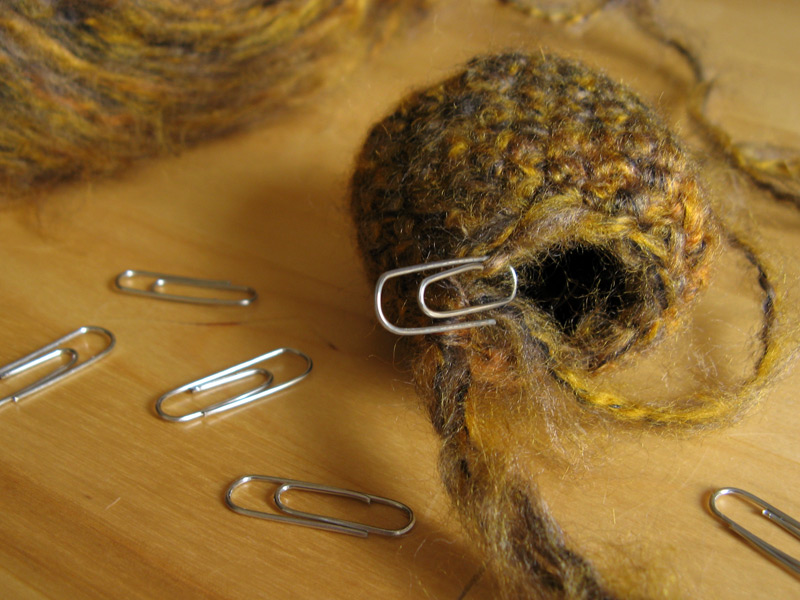
Always with a picture, here it is, the multifunctional paperclip or paper-clip!

"alternative stitch marker"

Maybe some of you haven’t thought of this yet!

Good night.


Face & expression, Tips & Tricks

Alternative animal eyes

Animal safety eyes and other nice looking animal eyes can be hard to find. When I started making amigurumi, I couldn’t find stores where I could buy them, so I had to come up with an alternative.

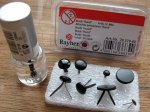
I went to my local hobby store to see what they had to offer. There I found something very suitable, called brads. They come in all kind of sizes and shapes and the black round ones make perfect eyes. The one thing that wasn’t perfect, they aren’t shiny. I had to make them shiny myself then. The first thing I thought of was transparent nail polish and that actually did the job very well. A few layers of it and an afternoon of drying made the eyes perfectly shiny and smooth.

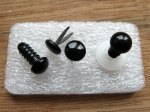
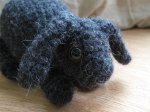
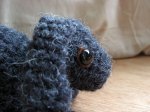
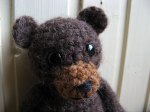
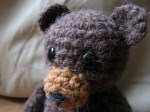
Here are some pictures of the brads and how they look as eyes on a crochet animal. There’s also a picture of another way to make particular eyes. Below the images I’ll explain how it works. (You can click on the image to get a larger version.)


The last image is of normal safety eyes with a felt patch behind it.

How does it work?

First, pin the brads to a pin cushion or something else you can put them into, so they stand up steady and you can nail polish them. Attach a layer of nail polish. If the first layer looks perfect, it’s good, if it’s not smooth enough yet, add another layer when the first layer is dry. When you’re satisfied, let your brads dry for a while, I let them dry for a night before using them.

Make sure the nail polish is completely dried out when you attach the eyes, otherwise you’ll damage them. At first only the upper layer is dry and not very steady. When it’s perfectly dry, it should stay undamaged even if you scratch it. If you like, you can paint various coloured eyes with nail polish, like a blue eye with a black pupil. And my advice, polish a bunch of eyes in advance and keep them safe till you need them.

When you use brads as eyes you need to make sure the paws won’t stick out of the crochet ‘skin’. If you crochet very tight it might not happen but you can also add a piece of paper(board) or felt between the paws and the inside of the piece, so when the paws are spread they only touch felt or paper.

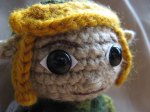
To give more character to some eyes, you can add a piece of felt behind the eyes on the outside. In the crochet bunny picture you can see I used brown felt behind the eyes, and the Link amigurumi has white felt behind normal safety eyes.

Another tip:

If you use felt for characteristic eyes, you can dye it first with acrylic paint, to make it more strong. I did that with the Link amigurumi’s eyes. Because without the paint the felt fell apart when I cut it in the right shape. Whit the paint on it, it stayed felty but much stronger and easier to cut.

One last note:

I do NOT think the alternative eyes are safe for little kids toys, so use safety eyes if you make them for a little kid.

I hope this post comes in handy, good luck!