Stories

A Son’s Popkes Summer break

In the meantime…

I’ve started working on a new pattern, a Corgi dog! I’m hoping to publish it the last week of September.

🐶

Last week, I thought it would be a great idea to share some behind-the-scenes photos of my design process on Instagram. However, my timing was a little off, as Summer break is just around the corner. My boyfriend works in education and has a long holiday, and this break is important for me too. I choose not to work during this period or, to put it another way, I don’t start any new designs during these six weeks.

Taking this time away from thinking about ā€œhow should I do this?ā€ or ā€œhow can I create that?ā€ really helps to ‘unravel’ my mind. It allows me to return after Summer feeling refreshed and brimming with new ideas. Since much of my inspiration comes from nature, I use this period to wander outdoors and try to see as much wildlife as possible.

I’ve already had a fabulous experience in my village following a family of long-eared owls. I discovered the chicks just as they had branched and was able to follow them for several weeks. It was absolutely wonderful to watch them grow up. And just a few days ago, when I couldn’t find the owl family, I discovered there’s a kingfisher family living in a local pond. I had so much fun taking pictures of them hiding underneath a silly mosquito net!

Of course, new ideas always pop into my head, but for once, I don’t feel the need to act on them right away.

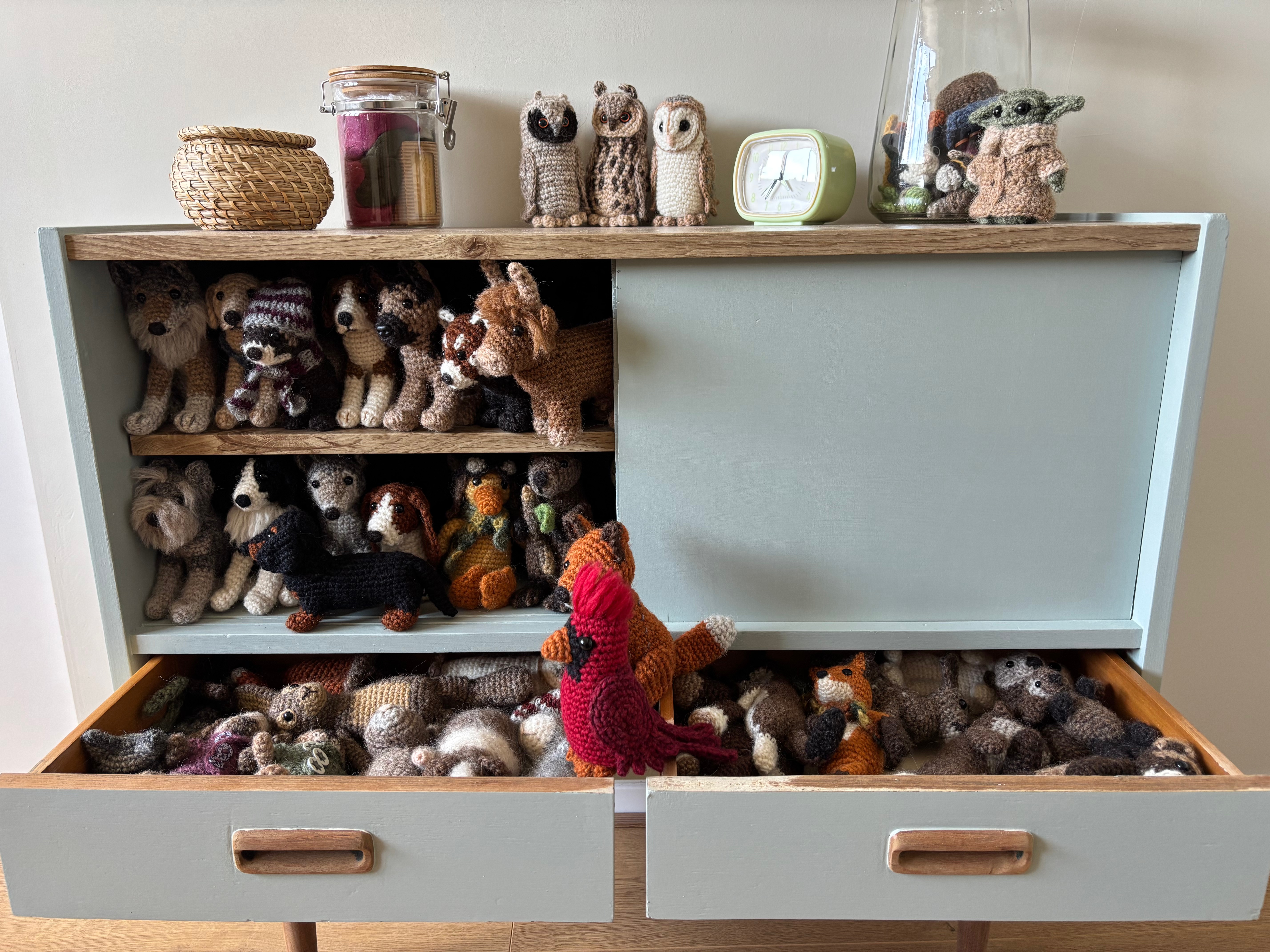
That said, I’m excited about the idea of sharing more Instagram stories about my creative process, and I plan to continue with that. I have a lovely home studio that I can’t wait to show you. It looks very organised right now, but when I’m working on a new pattern, my desk quickly fills up and things get delightfully messy.

After the Summer break, I’ll finish the sheep project I’m working on, and I’m also planning to create an improved tuxedo cat pattern. And my shops, of course, stay open, everything there goes fully automatically.

For now, I wish you a wonderful, fun, and adventurous Summer filled with yarn crafting and more. I’m currently knitting a rather cool stripy henley sweater, fingers crossed I can finish it!

Have fun, crafty peeps!

Patterns

Fronsky, realistic tawny owl pattern

It is with great pleasure that I present to you a new realistic crochet owl: Fronsky, the tawny owl!

realistic crochet owl

I had originally planned to create another animal, but this summer I saw my first adult tawny owl and later spotted a second one. Having seen tawny owl chicks this spring, I was eager to see an adult. After some research, I discovered a few roosting spots where owls are regularly seen. Visiting sites like these isn’t usually my thing, but for a chance to see a roosting tawny owl, I had to make an exception. During our first three visits, the owl was not present, which left me disappointed. However, on our fourth visit—a sunny afternoon—the owl was there! What a delightful sight it was! I found it almost magical how that gorgeous creature sat calmly and even looked at us from its perch. I was overjoyed and managed to take a few amazing pictures.

A few weeks later, we travelled to Germany. During a hike, we stumbled upon an old corn mill that showed signs of a roosting owl. There were droppings around, pellets, and feathers stuck to the wall. I checked for the owl but found none. Later that week, we took an evening stroll after a day of rain. As we walked the path to the mill, I wondered if there might be an owl now. When we were almost there, I carefully walked beneath a large chestnut tree and cautiously looked up at the mill. And there it was! A huge gray morph tawny owl perched on a beam—it didn’t even fully open its eyes when I looked at it. This one was much closer than the first one I saw, and I finally realized just how large they are. My holiday was perfect!

When I returned to work, my mind was so full of owls that the only thing I could do was crochet another owl pattern. Since I’ve already made several species of owls, I could easily adapt those patterns into a chubby tawny owl. That sounds easier than it is though, but at least I didn’t have to start from scratch. Real owls vary significantly in size, but I decided to make this one slightly bulkier because I like all my dolls to be about the same size. Choosing the colours for this owl was challenging; however, to keep it simple, I decided to omit the rust colours of the brown morph and instead go for a more greyish morph—like the owl I saw in Germany. This way, it can be made using only three colours, which is more than enough.

An interesting detail: for this owl, I adjusted the feet. Owls have two toes at the front of their feet and two at the back. When I made my other owls, I didn’t know this detail, and I bet many of you might not either.

Here are some more pictures of Fronsky the tawny owl amigurumi. Below them you can find all the information you need about the pattern.

Pattern Details

This is an intermediate pattern made with basic stitches. The difficulty lies in the colour changes; the strands can quickly become tangled, so you need to keep your focus!

This crochet owl is made with Istex Lett Lopi—a 100% wool yarn known for its fuzziness—and stands 5.5 inches (14 cm) tall. The pattern includes clear and colour-coded instructions on how to crochet and assemble the doll, along with instructional images and notes next to the text. You’ll also find pictures of the finished doll at the end. In the pattern, you’ll discover what materials you need as well as the yarn colour numbers—in short, everything necessary to create your own realistic owl amigurumi! All the additional information you need to know about this pattern you can find in the shop listings. You can purchase it in my shop at Ravelry or Etsy.

And heads up! This pattern has a one-dollar release discount until my birthday on October 6th. Feel free to let me know if you need any additional information!

Patterns

Bubbles, realistic crochet otter pattern

I finally took on the challenge of making a realistic crochet pattern one of my ultimate favourite animals, the river otter. Meet Bubbles!

realistic amigurumi otter

Some of you may think, ‘But you already made a river otter amigurumi’, and you are right. The first otter I made was Basil, and I later replaced Basil with Bubbly. They both are standing otters. Bubbly is a cute otter, but he didn’t turn out as realistic as I hoped.

And since then I have never dared to make a new version. Somehow otters are so difficult to capture in yarn … I even found that a badger pattern was easier to design. Otters have a special kind of face, with a very cute big snout. I had never managed to find a way to capture that.

This summer I was just playing around with some yarn and I suddenly had an idea for a muzzle: two bobbles above each other, one pushed in, one pushed out … It created a funny mouth that looked rather ‘ottery’. ā€˜Eureka’! I thought.

But even then I felt hesitant to make a new crochet otter pattern. The body was a dilemma too. Should I use the technique I used to make Bolthus the polecat, or could I adjust the dachshund body so it would resemble an otter’s body? I kept doubting what would work best.

In the end I preferred the technique used for the dogs on all fours. I could easily alter that shape to create an otter body with a high back and a wide tail. It’s surprising how much difference a few changes can make. I love this otter!

Here are some more pictures of this slippery but soft little otterĀ and below them you can find all the info you need.

For an experienced crocheter this is an easy pattern, and I always try to write it so that beginners can make it, too. The otter’s body is rather small, so once you’ve connected all the pieces, it works up pretty fast. I explain very thoroughly what stitches you need to work with, and I’ve added extra images to make sure you understand how everything works.

This crochet otter is made with Istex Lett Lopi, a 100% wool with a lot of fuzziness. It’s 9 inch / 23 cm long from the nose to the end of the tail and about 4 inch/ 10 cm high from the head to the ground. The pattern contains a clear and colour-coded description of how to crochet and assemble the doll, instruction images with notes next to the text, and pictures of the finished doll at the bottom. In the pattern you can also find out what materials you need, the yarn colour numbers — in short, everything you need to know to make your own realistic crochet otter amigurumi. All the additional information you need to know about this pattern you can find in the shop listings. You can purchase it in my shop at Ravelry or Etsy.

And heads up! This pattern has a one euro release discount till the 22nd of March.

Patterns

Torsbie, crochet long-eared owl pattern

This crochet owl pattern is very dear to me. Meet Torsbie and the owling, made after the owls that brightened my summer!

realistic owl amigurumi pattern

Owls are such gorgeous birds and I always wanted to see one for real, but they are very rare these days, and creatures of the night. This winter we often heard a long-eared owl singing in our largest tree, but I couldn’t find it in the daytime. Time went by and and I looked around for traces. White poo under a tree, feathers or pellets would reveal a daytime roosting spot, but I never found any.

Then one night when I was cycling past the nice field where I regularly spotted a hare, I saw a creature disappearing in the bushes. And then I heard unusual sounds, like squeaking doors. ‘Oh my,’ I thought, ‘could this be’? It was too dark to properly see, so I went home and eagerly searched online for owling calls. I had heard it right, there were owlets in those trees!

So I went back the next evening and a dream came true. In a large bush I saw a great ball of fluff with a black face and orange eyes. It was looking at me as surprised as I was looking at it. I walked to a better spot and eventually I saw four chicks. Every evening I visited them and saw them grow up into beautiful young owls. The parents I never saw in the evening, so I went out of bed before sunrise, and then saw one of the gorgeous adults too. How lucky was I that it was just sitting there watching me curiously? It was an amazing experience!

Of course now I had to make a long-eared owl crochet pattern. I could tell you all about the process, but just believe me when I say it was a very challenging pattern to design. These owls have such delicate features and I had to simplify it down to create a do-able pattern. And as a gift to you because of my happiness, I also added the instructions for an owling in the pattern.

Here are some more pictures of the amigurumi long-eared owls and below them you can find info about the pattern.

This is a pattern for experienced crafters. It’s made with basic stitches, but the many colour changes and the shaping of the owl don’t make it suitable for beginners.

This crochet owl is made with Istex Lett Lopi, a 100% wool with a lot of fuzziness. It’s 5 inch / 13 cm tall. The pattern contains a clear and colour-coded description of how to crochet and assemble the doll, with instruction images with notes next to the text and pictures of the finished doll at the bottom. In the pattern you can also find out what materials you need, the yarn colour numbers — in short, everything you need to know to make your own realistic owl amigurumi. All the additional information you need to know about this pattern you can find in the shop listings. You can purchase it in my shop at Ravelry, Etsy or order it here.

And heads up! This pattern has a one dollar release discount till the 28th of September.

Here a some pictures of the amazing owl family, because you must have become curious about them! In the last picture see a grown-up owling.

Patterns

Finnly, crochet Border Collie pattern

After a long break, I’m delighted to publish this new dog pattern! Meet Finnly, the realistic Border Collie, a fabulous amigurumi of one of my favourite dogs!

realistic crochet dog pattern

When I started making dog patterns I really wanted to do a Border Collie, but the long-haired features of this Collie kept me from actually making one. I started with less hairy dogs, and then must have gone mad to make a bearded Schnauzer pattern. That actually was a lot of fun to do, and it gave me much inspiration for how to do the Border Collie and other dogs. For the Schnauzer I had used ‘reversed loop stitches’ to create the bearded face, and I knew those stitches would be very suitable for any kind of hairy dog.

So some time in May I started the Collie design. The head was finished pretty quickly, but then a lot of things happened in my life, good things! We finally could move to a new home, away from that noisy house we tried to make our home for so long. Moving means a lot of things to do, so I put the dog on hold until we had settled down in our new home and I had enough ‘space in my head’ to continue designing.

It felt so good to sit down at my improvised desk with a new view and peace and quiet. I worked my way through the body and back paws and spend a whole afternoon on making the fidgety hairy tail. And now I have this amazingly cute mini Border Collie sitting on my desk, waiting to be made by many other Border Collie fans out there.

This is not a very difficult dog to crochet, the reversed loop stitches take some getting used to, but when you get the hang of it they actually are fun to do.

Here are some more pictures of this adorable crochet dog amigurumi and below them you can find info about and links to buy the pattern.

Info about & links to buy the pattern

This is a moderate pattern to make. Most parts work up pretty easily, but the reversed loop stitches for the head, chest and tail take some extra effort. The Border Collie dog is made with Istex Lett Lopi, a 100% wool with a lot of fuzziness. It’s 5.1 inch /13 cm sitting. The pattern contains a clear and colour-coded description of how to crochet and assemble the Collie, with instruction images next to the text and example pictures at the bottom to help you get everything right. In the pattern you can also find out what materials you need, the yarn colour numbers — in short, everything you need to know to make your own adorably mini dog. All the additional information you need to know about this pattern you can find in the shop listings. You can purchase it in my shop at Ravelry, Etsy or order it here.

And heads up! This pattern has a one dollar release discount until October the 20th!

Because I had so much fun designing this hairy dog and because it looks a lot like the wolf I used as an example when I made Woolfie, my next pattern will be a ‘Woolfie advanced’. I think you can imagine how that’ll look! And after that… a realistic otter, I want to make a red cardinal bird, a skunk and a poodle. Oh, there are so many lovely animals to make next, see you soon!

Patterns

Free mini Easter bunny ears pattern

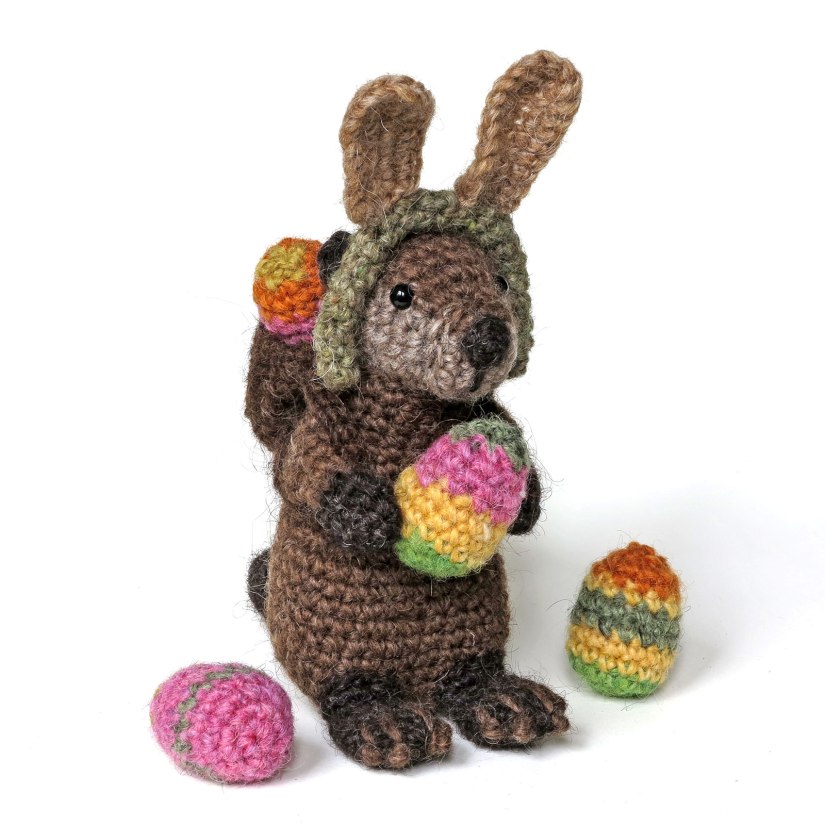
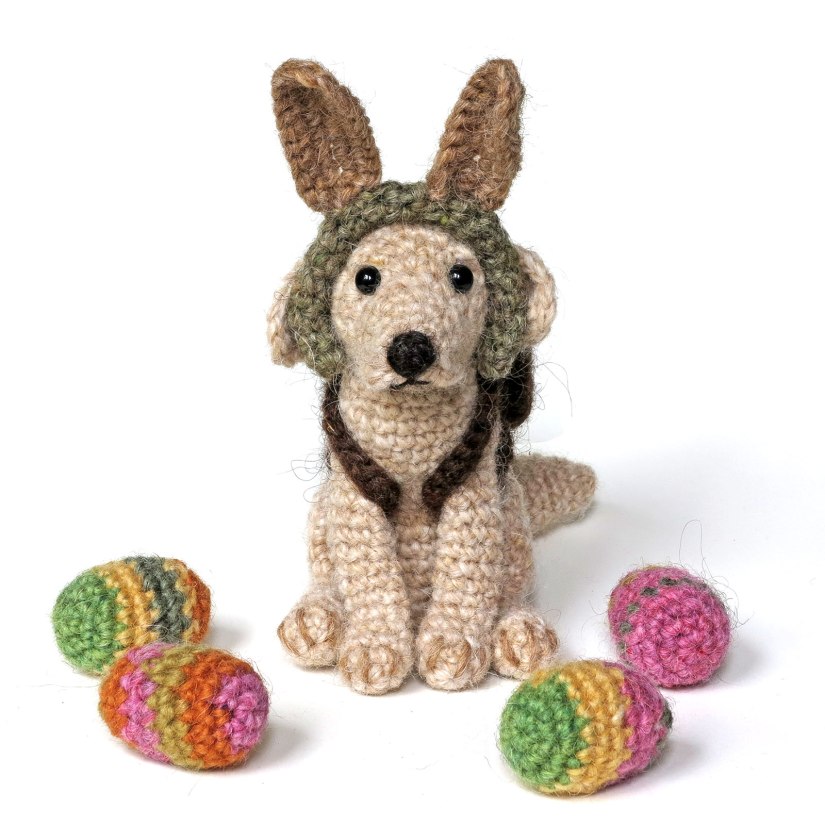
This is a must have pattern for all you Popke fans and amigurumi makers out there. With these fabulous bunny ears, you can turn each and every crochet animal into an Easter bunny. How exciting is that!?! It’s a super simple pattern and easy to adjust in size.

Just look at these two ā€˜new born’ Easter bunnies!

Instructions

For this pattern you need worsted weight yarn and hook E US/ 3,5 mm. I’ve used Lett Lopi yarn; colours barley 1419 and pale green 9421. You’ll also need sewing materials and a pipe-cleaner for the headband.

Ears

1. ch of 9, in 2nd ch from hook 2 sc, sc in next 6, 2 sc in last, turn, 2 sc in bottom loop of next, sc in next 7 = 19

2. ch 1 and go back, sc in 2nd ch from hook, sc in next 7, 2 sc in next 2, sc in next 8, sl st in last and leave yarn end for sewing. Weave in the other yarn end.

If the ears you made curl all different ways you don’t like, make them doubled. I didn’t do that because I like the playful effect. If you need bigger ears, repeat round 2 but do 8 sc’s before the increase and so on.

Headband

1. magic ring of 4 = 4

2-21. sc in each around = 4, sl st in 1st (keep going if you want it to be longer)

22. sc in each around = 4, sl st in 1st and leave yarn and for sewing.

Now stretch the tube and insert the pipe-cleaner. You can sew the band closed by putting the needle from the inside out through all the outside loops of the 4 st, clockwise. If you do it correctly, you can pull the yarn end and it will close the gap.

All you have to do now is attach the ears to the headband, about three rounds apart and a bit folded together at the bottom so they are a bit hollow.

There, now you can give all your Popkes an Easter bunny metamorphosis!

Here you can find the free pattern for Easter eggs and a little basket. You can easily turn the basket into the backpack you see in the pictures, by adding an extra strap to it.

Thank you Rafi Made It for giving me this lovely idea!

Patterns

Nims and Ermine, realistic crochet stoat pattern

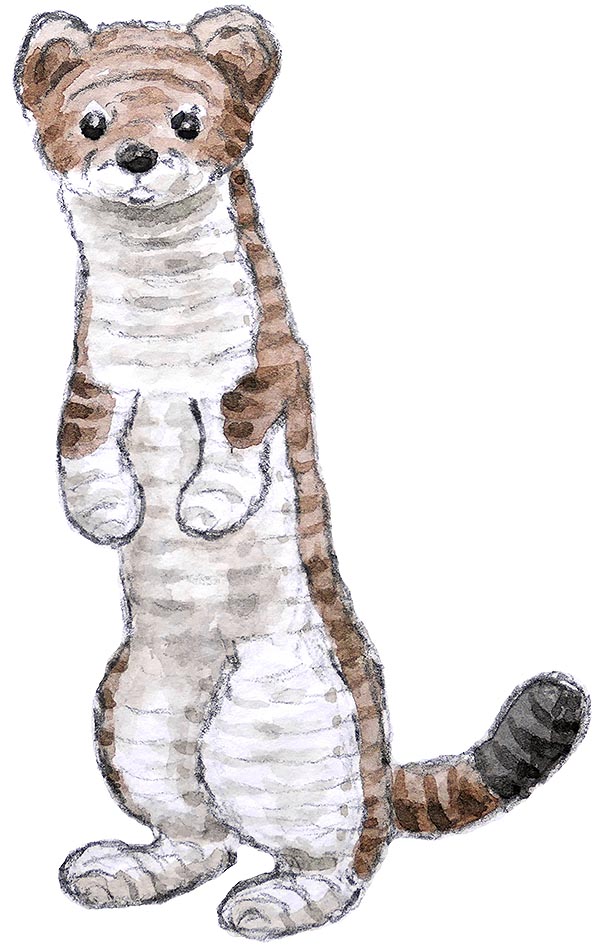
With much joy I present to you my first seamless amigurumi pattern, Nims and Ermine the stoats.
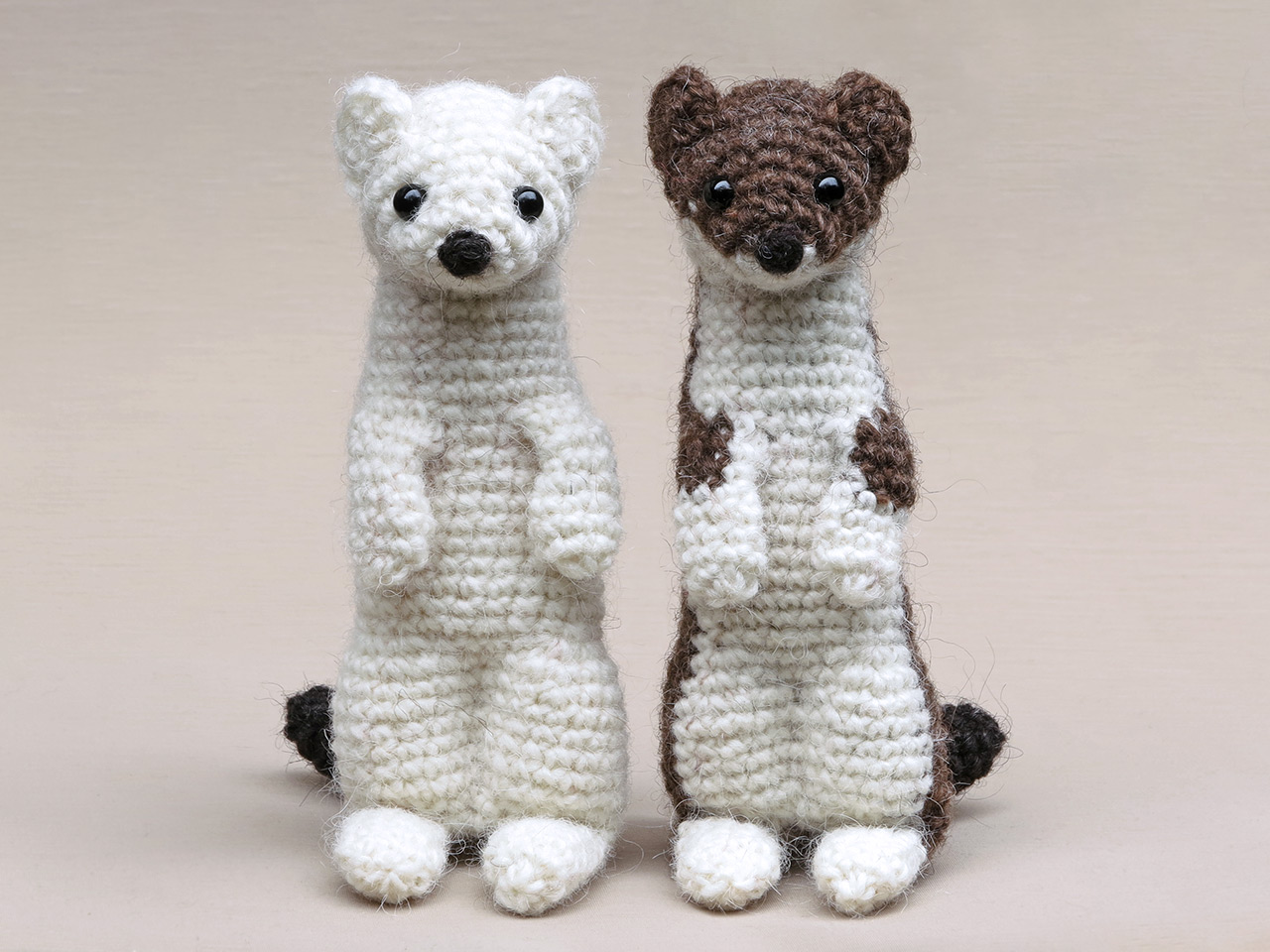
realistic amigurumi stoats

Ermine is the term used for animals that turn white in winter, hence the name for the white version. And with this pattern you can make a weasel too, they look quite similar except for their shorter tail without the black brush-tip. So if you skip that part you can make a weasel. Keep in mind, though, that in most parts of the world weasels don’t turn white in winter.

This animal took me the longest time ever to design, and I’ve learned so much much during the process. I stumbled upon many difficulties, and several times I almost gave up. But every time I decided to stop, I either got an idea of how to fix the difficulties, or I just realised it would be a waste to give up after all the time I had spent designing this already cute crochet animal. Now that Nims and Ermine are finished, I absolutely love the result, and I am glad that I didn’t give up.
Designing this pattern actually turned everything upside down, literally and figuratively speaking. Normally I design the head and then a body from the bottom up. But this time I designed the head and worked my way down, creating holes for the arms, designing hips, and continuing with the legs. Where I normally did increases, I now had to do decreases. I also used a different technique to create the bend for the neck. Early on I worked with short rows, but that results in a different texture of stitches. I discovered that there is another method where you crochet a chain to the first part of the head and continue working on the head and the chain, decreasing stitches to close the back of the head. When the head is finished, you attach a new strand of yarn to the other side of the chain and work downwards for the body, with not a seam to be seen.

This all works out perfectly well for a single-coloured doll, but a big challenge introduced itself when I started on the duo-coloured stoat. Now that technique with the chain became a difficulty, because the chain itself had to become duo-coloured. I had trouble with the tension, and the unused yarn was in the way; it just seemed undoable. It was only after I decided that this was an impossible pattern that I had the rather brilliant idea to carry the unused colour upwards on the chain. I don’t always carry the yarn with me in every stitch, but leave most of it resting against the inside of the work. The reason for that is partly because I find that easier, and also, when you work with sharply contrasting colours, you can see the yarn showing through the stitches. But for a chain it worked like a charm. The tension was good and you have both colours with you when you need them. I was delighted I had this fixed, and I finished the stoat in its Summer coat.

A seamless animal works up quickly and pleasantly when you have a pattern, but when you are designing the pattern, it takes much more time. Only when the stoat was finished was I able to see how it looked and what needed to be changed. Many times it wasn’t possible to just unravel a short bit, and I had to start all over again.
For the last version, I only had to change the colouring for the neck using the pattern I had made. But somehow for this version, the middle was off, and I couldn’t figure out why. I did it again, exactly the same as before, took it apart, tried again but still it looked crooked! It was so frustrating!

Sometimes what seems a big problem has a solution so simple, you never think of it. At some point I started fumbling around with the body, and I realised that it wasn’t crooked at all but just rotated too much. I just had to twist it to get it straight! The reason that this can occur must lie in the length of the body: when you work in a spiral in one direction and pull the piece in that direction all the time, it starts to look crooked. After I twisted the body, it now looks the same as the other versions, and that’s the stoat you see in the pictures.

To sum things up, this was the most challenging pattern I have made so far, and I almost lost my mind at one point, but it was totally worth it! I have mastered many new skills, and you will too! The stoats look realistic and cute at the same time!
Here are some more pictures of the seamless stoat amigurumi, and below them you can find all the info you need about the pattern.

Info about & links to buy the pattern

The pattern for the seamless, realistic crochet stoat is a bit more challenging to crochet than my other patterns. Working seamlessly requires different techniques that can be difficult for beginners; making the white version first could help you learn and master these skills. This animal is made with Istex Lett Lopi, a 100% wool with a lot of fuzziness. It’s 6.3 inch / 16 cm standing. The pattern contains a clear and colour-coded description of how to crochet and assemble the doll, with instruction images next to the text and example pictures at the bottom to help you get everything right. In the pattern you can also find out what materials you need, the yarn colour numbers — in short, everything you need to know to make your own lovable stoat. All the additional information you need to know about this pattern you can find in the shop listings. You can purchase it in my shop at Ravelry, Etsy or order it here.

And heads up! This pattern has a one dollar release discount until February the 21st.

Patterns

Bolthus, realistic ferret aka polecat pattern

I’m so delighted I can finally present to you my new and realistic ferret or polecat pattern. This is Bolthus, a crochet animal on all fours!

realistic ferret crochet pattern

When I started designing crochet animals I wanted to make playful, comic-looking dolls that looked realistic enough to resemble the real animal but are dolls. As I continued designing patterns, the realistic look became more and more important. I started making realistic sitting animals like the wolf and cat, and occasionally I designed an animal on all fours like the guinea pig, realistic hedgehog and badger. I’ve always found it extra challenging to design an animal on all fours, mostly because playfulness is important for my designs and a standing animal might look too stiff and statue-like.

So designing this very realistic ferret amigurumi was a big step. I wanted to keep it as simple and seamless as possible. I started designing the head and quickly realised that it would look very realistic if I made the head and neck in one piece. But that created difficulties: how could it be attached to a body? I’d already decided I was going to crochet the front paws and chest as one piece bottom-up, so now I had a head and neck crocheted top-down that I had to attach to a chest that was crocheted bottom-up. Sewing together two openings like that is very illogical, so I had to figure out a method to crochet the chest and front paws top-down continuing from the neck.

Normally I would crochet the paws first, crochet them together and work ahead for the body. Now I had to do it the other way around. Continuing from the neck, I crocheted the chest, and when it was long enough I split it in half to crochet the paws seamlessly to it. It worked like a charm!

So now I had a finished front piece that needed a back. Designing the back of the body was pretty straightforward, I just needed to figure out the right size and shaping. After a few attempts and a bit of help from my Instagram followers, I had the perfect long ferret body. Now all that needed to be done were the back paws and the tail. The back paws were a bit challenging because they needed a particular shape, but with some practising I managed to get them right. The tail was easy peasy!

The most exciting part came when all the pieces were finished: assembling the crochet ferret. For me this always takes a lot of effort, to get everything in the right place and write it down understandably for you. Sewing the back to the front piece needs to be done very precisely, and I think it is the most challenging part of this pattern. But if you do it with patience he’ll turn out fabulous.

My worries that an animal on all fours would become stiff didn’t turn out to be justified. I absolutely love this crochet ferret and find him very mischievous and playful-looking. I hope you like him as much as I do!

Here are some more pictures of this ferret or polecat amigurumi, and below them you can find all the info you need about the pattern.

Info about & links to buy the pattern

The pattern for this realistic crochet ferret/ polecat is pretty straight forward. The colour changes and assembling require some extra concentration. This animal is made with Istex Lett Lopi, a 100% wool with a lot of fuzziness. It’s 9.5 inch / 24 cm from nose to tail end. The pattern contains a clear and colour-coded description of how to crochet and assemble the doll, with instruction images next to the text and example pictures at the bottom to help you get everything right. In the pattern you can also find out what materials you need, the yarn colour numbers — in short, everything you need to know to make your own ferret. All the additional information you need to know about this pattern you can find in the shop listings. You can purchase it in my shop at Ravelry, Etsy or order it here.

And heads up! This pattern has a one dollar release discount until Thursday, the 12rd of August!

Patterns

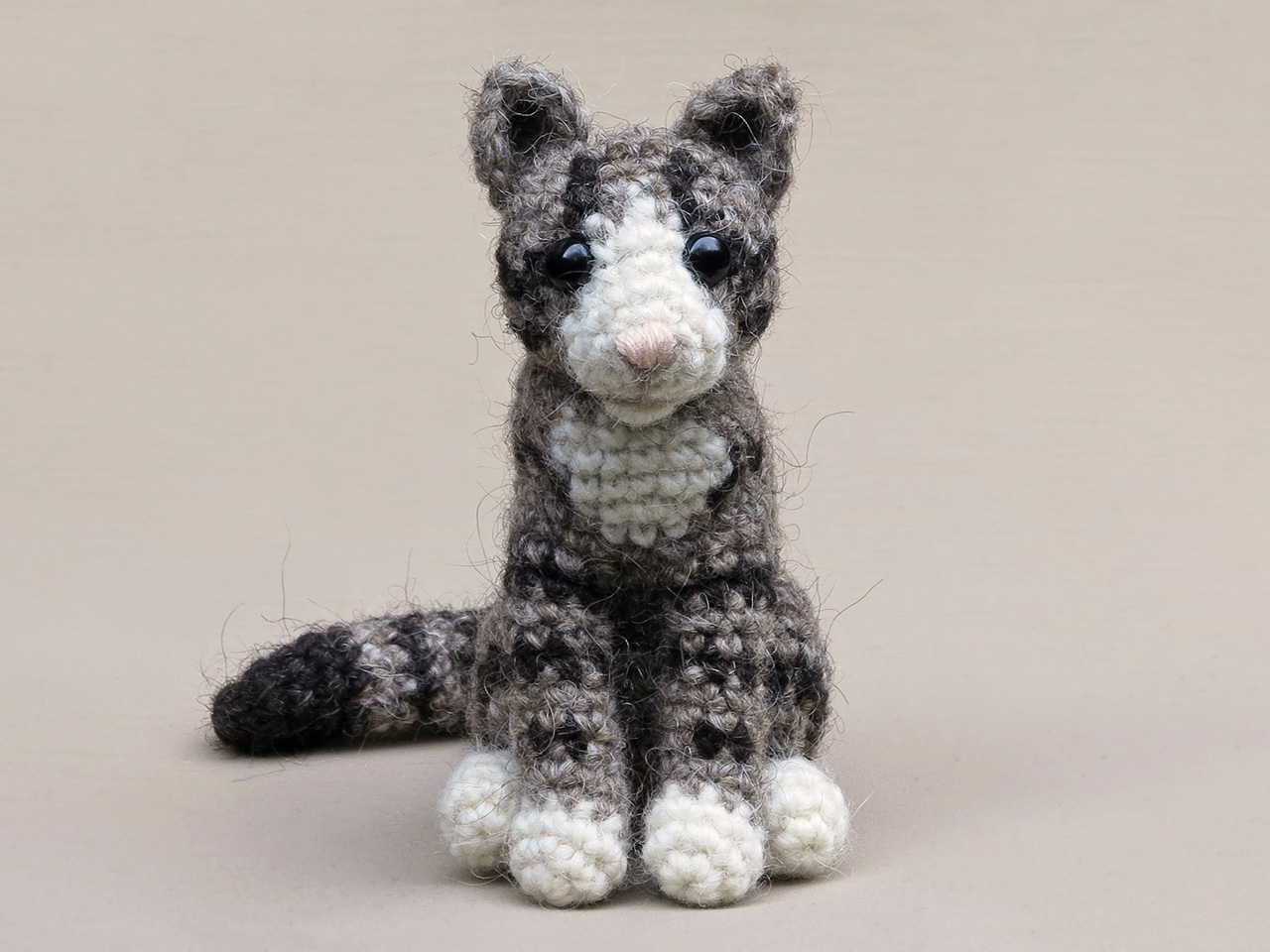
Balthazar, realistic crochet cat pattern

This must be the most mischievous-looking amigurumi cat you’ve ever come across! I proudly present to you my playful and realistic crochet cat pattern.

Realistic crochet cat

Whilst writing this blogpost, Balthazar is standing opposite me on my desk looking like he’s up to no good. I have no idea how I do it, give an animal an attitude like that. It seems like it just happens, or perhaps I unconsciously prefer the version that has that slightly imperfect feature and I decide that will be the final version. Anyway, this new and realistic crochet cat looks like an adolescent cat that is fun to play with.

And that was my goal to begin with. Cats are the most cuddly, soft and lovely pets one can wish for, but they also are the most silly housemates you can get. So I had to get that characteristic in both the face and the posture. When I started working on the head, I realised cats have a distinctive-looking snout, a small nose, an almost laughing mouth and that lovely chin I always loved to touch when we still had a cat. I had to figure out a way to create a little chin (without it being a sewn-on piece), which you can easily outline with a sewn-on mouth. At some point I got an idea that was both a super-easy thing to crochet and that worked perfectly.When you make this cat, you’ll find out the simple trick I used.

When I started working on a cat pattern, I wasn’t sure yet what type of cat I should make, so I tried out several different versions. It was a lot of fun, but it also created a dilemma: which one will I finish? And should I make separate patterns for each kind or add these to one pattern? For now, I decided to just publish one pattern, of the tabby cat. But I probably will make an add-on pattern later for different kinds of cats.

When I designed this pattern, I wanted a cat that could both sit down with a relaxed grin, but also would be a playful doll for children. So it had to be flexible, and that is why I chose loose hind legs, to make the cat just a bit more playful than a seamless cat would be. I had so much fun doing this photoshoot, at some point I started the ‘playful’ pictures, and they turned out so lively, I was delighted with the result.Ā  Just take a look at this! Below these pictures you can find all the info you need about the pattern.

Info about & links to buy the pattern

This crochet tabby cat is not very difficult to make, except for the colouring of the head, which takes a lot of attention. For some rounds you change colour stitch after stitch, and one unspotted mistake ‘messes the whole thing up’. I added extra pictures for these complicated rounds, and it is just matter of recounting each round you’ve finished to be sure you’ve done it right. The rest of the pattern should be easy to do; attaching of the front paws needs some extra attention but I added extra images there, too.

This cat is made with Istex Lett Lopi, a 100% wool with a lot of fuzziness. He’s 5.1 inch /13 cm sitting. The pattern contains a clear and colour-coded description of how to crochet and assemble the doll, with instruction images next to the text and example pictures at the bottom to help you get everything right. In the pattern you can also find what materials you need, the yarn colour numbers — in short, everything you need to know to make your own realistic crochet cat. All the additional information you need to know about this pattern you can find in the shop listings. You can buy this pattern in my shop atĀ Ravelry, Etsy or order itĀ here.

And heads up! This pattern has a one dollar release discount till Thursday, the 11th of December!

Patterns

Crowly, crochet raven pattern

I hereby present to you yet another dark and mysterious creature: meet Crowly the crochet raven, or crow, that’s up to you!

amigurumi crow

I’ve wanted to make a raven or crow for a long time, but until now I hadn’t gotten into it. Crows aren’t cuddly cute creatures, but they are very intelligent and compassionate. I’m fascinated by them, and I especially love ravens. For a few years now we’ve seen ravens in the areas we hike. Well, most of the time we just hear their ‘krok krok krok’ call.

Now why have I called my raven amigurumi ‘Crowly’? To be honest, I wasn’t sure wether to make a crow or a raven. I assumed crows would be more loved and popular than ravens, so when I first started I was thinking Crowly should be a crow. But because ravens are my personal favourite, I wasn’t sure what to choose.Ā 

I think this pattern offers the option for the crafter to decide what it is. Ravens and crows both belong to the corvids (corvidea) species. There are differences between the animals, especially the size and the shape of the wings, but this pattern isn’t realistic enough to show them. The details I added for the wings will work perfectly for either a crochet crow or raven, or even a rook if you make the top of the beak black.

Here are some more pictures of this adorable crochet raven/ crow, and below them you can find info about and links to buy the pattern.

Info about & links to buy the pattern

Crowly is made withĀ Istex Lett Lopi, a 100% wool with a lot of fuzziness. If you use the recommended yarn, your bird will beĀ 5 inch / 13 cm standing.

The pattern is written in US terms and contains a clear and colour-coded description of how to crochet and assemble the animal, with extra illustrations and example pictures at the bottom to help you get everything right. In the pattern you can also find what materials you need, the yarn colour numbers – in short, everything you need to know to makeĀ your own cuddly corvid. All the additional information you need to know about this pattern you can find in the shop listings. You can buy this pattern inĀ my shop atĀ Ravelry,Ā EtsyĀ or order itĀ here.

This pattern has a one dollar release discount till Thursday, the 25th of December, Christmas day! If you like to see quick updates about my work, please follow my Instagram page.